



Rankine Forrester
Many grandparents read to their grandkids — often classic storybooks. Rankine Forrester's grandmother spent hours with her young grandson on her lap, reading, but her favorite book to share wasn't a childhood staple like "Curious George" or "The Little Engine That Could." Instead, she and Rankine enjoyed reading a bird identification guide.
Those early lessons shaped Forrester's childhood.
"From that, my family decided I like birds, so everything I got for Christmas and my birthday had to do with birds," Forrester said. "So, I'd go through books, and I could identify all birds. I knew every North American bird. When I was a kid, I went to Cornell's ornithology school one summer because my parents thought I loved birds."
To set the record straight, Forrester isn't "bird crazy," nor has he become an ornithologist. But he still appreciates birds, and he remains adept at identifying them, especially flocks of ducks approaching his duck blind.
Forrester was raised in Upstate New York, where his father hunted grouse, pheasants, and woodcock far more often than ducks.
"I did that as well, but once I could drive, my friends and I would go to Arkansas, and we'd hunt waterfowl locally (in New York)," he said. "We just hunted where we could, whenever we could. I've been a duck hunter my whole life."
Now, Forrester lives in the St. Louis area and serves as chief executive officer of Intoximeters, a company that makes breath alcohol testing instruments for law enforcement and workplaces. Conveniently, most of his hunting occurs on backwaters of the Mississippi River just north of the city.
"I can look out the window at work and see if the wind's blowing from the north, and I'm out the door," Forrester said.
Forrester first learned about Delta's conservation work by hunting with Charles Elcan, who served on Delta's Board of Directors from 2019 to 2025.
"I'm intrigued by the mission," Forrester said. "I'm a big numbers guy. What Delta is doing to increase (duck production) yield seems equally important, if not more important than only conserving habitat."
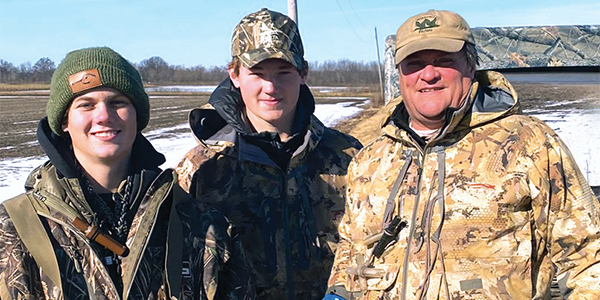
As a father to Sam, 20, and Chase, 18, Rankine Forrester has proudly mentored his sons as duck hunters.
"Both of them love it," Forrester said.
Importantly, Forrester is also mentoring his sons to become conservationists. Sam and Chase listened to presentations on Delta's work and came away impressed by how the Hen House and Predator Management programs increase duck numbers. Matching the universal sentiment of waterfowl hunters everywhere, all three Forresters want to see more ducks.
"I wanted to engage my kids in Delta's work, so I gave a large sum, and my kids (together) matched it," Rankine Forrester said. "I really wanted to get my boys thinking about supporting Delta."
Delta's mission to secure a strong future for duck hunters resonates with many donors.
"Helping Rankine support Delta Waterfowl alongside his children has been a wonderful experience," said Michael Coleman, Delta development director for Missouri. "When he mentioned wanting to include his sons in conservation, I knew this was about more than putting ducks back in the fall flight. It was about passing on a love for waterfowl hunting and the responsibility to protect it for the next generation."
Even with his eyes on the future, Rankine Forrester enjoys seeing — and identifying — every duck that flies past.
"Early in the season, there's nothing better than the first day or two of wood ducks when you get eight or 10 of them coming at you from every direction. They're a great duck to eat, and it's a great start to the season. That's a ton of fun," he said. "There are those days when they're grouping up. I love teal on a windy day. You'll see a black duck in a flock of mallards and try to work him in.
"I'm investing in Delta for my kids and their kids, hopefully. I value duck hunting with all my friends, sitting in a blind seeing the sun rise, being in tune with things, and being out of the office. It's all the reasons we duck hunt." — Paul Wait


 I need more information about ways to give
  I already know how I would like to give